Sample preparation
From raw material to precision specimen: Specialized workflows for mechanical, thermal, and paleontological sample engineering.

From raw material to precision specimen: Specialized workflows for mechanical, thermal, and paleontological sample engineering.
Our Sample Preparation facilities provide the essential foundation for high-precision experimental research, offering specialized workflows for geological, paleontological, and synthetic materials. We offer a comprehensive suite of tools for the mechanical processing of geomaterials, including high-stability rock coring, precision cylindrical grinding for complex 'dogbone' geometries, and large-scale cutting. Furthermore, our laboratories facilitate the synthesis and thermal treatment of melts and minerals at temperatures up to 1700°C, alongside dedicated micropaleontological 'sludge' labs for the chemical and mechanical extraction of microfossils. These facilities ensure that all specimens—whether for mechanical testing, isotopic analysis, or taxonomic study—are prepared to the highest standards of accuracy and reproducibility.

© Yan Lavallée
Room C330
Contact: Werner Ertel-Ingrisch
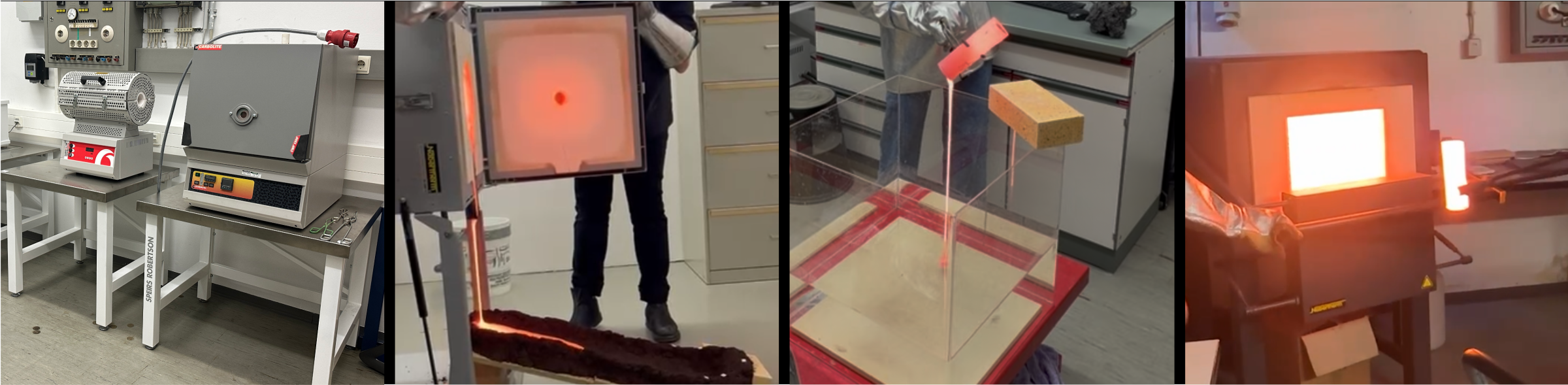
We also have very high-temperature Nabertherm box furnaces, operating up to 1700 °C, and of variable sizes (up to ca. 35L), to synthesise melts, glasses and rocks in air. We also have a setup to synthesise samples under controlled atmospheric chemistries (in the gas-mixing lab).

© Jackie Kendrick
Two rock corers are available for various sample preparation needs. A fixed pillar drill provides high stability and superior torque for coring dense or tough samples. A frame-mounted portable corer offers greater versatility for drill penetration depth. Both corers accommodate drill bits up to 80mm diameter.

© Jackie Kendrick
Saws of various sizes are available for the preparation of rock specimens. The largest saw can accommodate blocks up to 40kg, whilst smaller saws for precision cutting of parallel faces of rock cores for experimentation, or flat surfaces for thin section preparation are also available.


© Dirk Erpenbeck
Our histology facility provides specialized procedures for processing biological samples and hard substances for fluorenscence microscopy. For investigations at the cellular level, we utilize a fully automated rotary microtome (Leica RM2255). This device produces sections of 1 to 10 µm from tissues embedded in paraffin or Technovit. To protect the precision blades, mineralized components such as carbonate or silicate skeletons are decalcified prior to sectioning.

© Dirk Erpenbeck
To visualize 3D skeletal structures in hard materials like corals or sponges, we employ a saw microtome (Leica SP1600). Using diamond-coated blades, it creates 50 to 400 µm thick sections from samples embedded in synthetic resin (LR White). Finally, a selection of specific dyes and reagents is available to contrast target tissues and cellular structures for detailed microscopic analysis.
