Experimental volcanology lab

Deciphering volcanic triggers and plume dynamics through rapid decompression, large-scale ash settling, and lava-substrate interaction

The Experimental Volcanology facility includes a range of bespoke apparatus to simulate volcanic processes (including explosive fragmentation, volcanic lightning, lava flows, volcanic ash settling and aggregation, and volcanic sintering), whilst monitoring via high speed optical and thermographic cameras, pressure sensors, acoustic emission sensors and more. The facility extends to Geothermal research and further includes a range of Material Testing, Petrophysics and petrological instruments to characterise material properties.

Fragmentation Laboratory

Rooms
C U 127B C 106
Contact person
Bettina Scheu, Ulrich Küppers
Access regulations
only trained users

© Bettina Scheu

The fragmentation laboratory counts five bespoke shock-tube apparatus (fragmentation apparatus) to investigate processes associated with explosive volcanism. The apparatus allows us to explore the response of magma or porous rocks to 1) rapid gas decompression and/or 2) gas overpressure, whilst monitoring fragmentation, fragment ejection, and interaction with the atmosphere.

The apparatus permits the investigation of:

  • volcanic eruptions driven by rapid decompresion (fragmentation dynamics and efficiency)
  • phreatic and hydrothermal (steam-driven) eruptions
  • decompression of hydrous melts or magma analogues
  • the influence of crater geometry on gas-and-ash cloud dispersal
  • development of lightning due to electrical discharges upon fragmentation and eruption

© Bettina Scheu

  • the influence of atmosphere chemistry and pressure on fragmentation and lightning

This is possible using the fragmentation apparatus that contains a gastight, collector tank, capable of moderate under-/ over-pressure and connected to a gas-mixing system to mimic fragmentation and gas-ash dispersal in various atmospheric conditions, as experienced in early Earth history or planetary conditions. The ash and fragments produced as as well as the atmopsheric gas can be sampled for further analysis. The particle collector tank is designed as a Faraday cage to measure electric charges during fragmentation and expulsion of particle-gas mixture.

  • The autoclave is pressurised via Ar, N2 operating at different pressures (0.1-20 MPa) and temperatures (20°C - 900°C)
  • The collector tank is held at ambient temperature (20°C), and can operature at different pressures (25 - 400 kPa) whilst acommodating different gases (Ar, N2, CO2, CO)

  • Fragmentation behaviour: fragmentation threshold, speed, energy partitioning, fracture propagation dynamics and grain size distribution
  • Ejection behaviour: ejection speed, ejection angle, evolution of ejection plume
  • Dynamics of steam-driven fragmentation: vapor expansion, steam flashing, ejection speed, grain size distribution, energy partitioning
  • Effects of alteration on magmatic and steam-driven fragmentation
  • Permeability (via the pulse-decay method)
  • Vesiculation, foaming and foam collapse or fragmentation of natural and synthetic magmas subjected to different decompression paths

  • Autoclave, pressurised with gas (argon nitrogen or water vapor), and separated from a large low-pressure tank (3m high, 0.4m wide) by 1-3 rupture discs (diaphragms) to control the total pressure differential
  • The autoclaves can be housed in a split-tube furnace to heat and/or melt the materials before fragmentation
  • Tests can be conducted with transparent, perspex autoclaves to permit imaging of the fragmentation process via high-speed video cameras
  • The lower part of the low-pressure tank can be replaced by a perspex tube to permit imaging of gas and-ash ejectas via high-speed video cameras
  • The low-pressure tank can be sealed gastight to simulate moderate underpressure and to control the chemistry of the gas atmosphere to simulate exotic planetary or early Earth conditions.
  • The atmospheric gas can be sampled from a dedicated exhaust air line by attaching crimp cap bottles. Additionally, the particle collector tank is designed as a Faraday cage, which allows determination of the net electric charge of the particle gas mixture and the number and intensity of discharges.

  • Temperature and Temperature range:
    gas driven experiments: 20°C - 900°C & 0.1 - 50 MPa
    steam-driven experiments: 100°C – 400°C & 0.1 – 25 MPa
  • Natural cylindrical rock samples; standard sample size: 25x60 mm, other sample sizes possible (in mm): 19x50, 25x60, 60x60, 34x70 (diameter/height);
  • Natural loose samples (ash, lapilli): stacks of up to 240 mm possible
  • Magma analogues: silicon oils (102 – 106 Pa.s), with / without particles


  • 1-4 static and quasi-static pressure sensors (Kistler and Piezocryst): pressure evolution during heating, rapid depressurization across the sample, vent exit pressure
  • 1-2 k-type Thermocouples: Temperature of sample, temperature at diaphragm holders
  • Imaging system: 2 Phantom V711 high-speed cameras (up to 80,000 fps) with LED and/or HQI lighting system

Ash seTtling and Aggregation Gear (AshTAG)

Rooms
C U127B
Contact person
Corrado Cimarelli, Antonio Capponi
Access regulations
mandatory safety induction

AshTAG experimental apparatus (Capponi et al., 2026): a) schematic; b) image of showing particles (in white) distributed in the atmosphere (black) | © Antonio Capponi

AshTAG is a bespoke, large-scale, particle sedimentation and aggregation chamber designed to investigate the dynamics of volcanic ash in controlled laboratory conditions. It comprises a precision-controlled ash dispersion system (0.6 × 0.6 × 0.6 m) mounted above a 1.5 × 1.5 × 3 m fall chamber. The custom-built release mechanism enables the formation of sustained (up to several minutes), repeatable columns of falling ash particles. AshTAG is specifically designed to simulate and measure key processes involved in ash cloud evolution, including particle settling dynamics, aggregation, disaggregation, and preferential concentration. Its modular and flexible design allows to independently control a wide range of experimental parameters, such as particle size, concentration, humidity, turbulence, and ash surface properties (e.g., liquid volume and chemistry). This makes AshTAG a powerful tool for replicating and quantifying complex ash-atmosphere interactions in a reproducible and simplified setting.

  • Particle kinematics: velocities, release rates, and settling rates
  • Particle interactions: aggregation, disaggregation, and collision dynamics
  • Particle Size Distributions (PSDs): spatial and temporal resolution of ash size variations
  • Clustering metrics: preferential concentration patterns and volume fraction estimates

  • Chamber dimensions (incl. release system): 1.5 × 1.5 × 3.6 m
  • Variable ash loads: from a few tens of grams up to several kilograms per experiment
  • Flow control: configurable release rates (constant or time-variable) precision-controlled via linear actuators (0.025 mm/step)
  • Particle properties: adjustable PSDs and ash surface liquid content and chemistry

  • PIV system: Phantom V711 high-speed cameras (up to 20,000 fps for PIV) with Oxford Laser Firefly 300W pulsed laser
  • Environmental monitoring: Sensirion SEN55 environmental sensor, dor continuous monitoring of relative humidity, temperature, and PM (PM0.1, PM2.5, PM4, PM10) via laser scattering sensors
  • Macro imaging for aggregation/disaggregation: Modified BackBone GoPro Hero 12 with interchangeable macro lenses (250 fps)
  • Real-time ash release rate monitoring via fast-response load cells
  • Deposition monitoring: weighing tray at chamber base (model TBD)

Lava Flow Interaction with Substrate

Room
C U123
Contact person
Yan Lavallée
Pouring lava at 1100 degree Celcius

Lava flow simulator | © Honor James

This setup is designed to permit the flow of lava onto various substrates (rocks, volcaniclastic deposits, mud, ice) in air or underwater. It allows the melting of 3L of rocks up to 1250˚C
Volcanic Sintering Laboratory

Room
C 317
Contact
Yan Lavallée
Access Rights
upon appointment

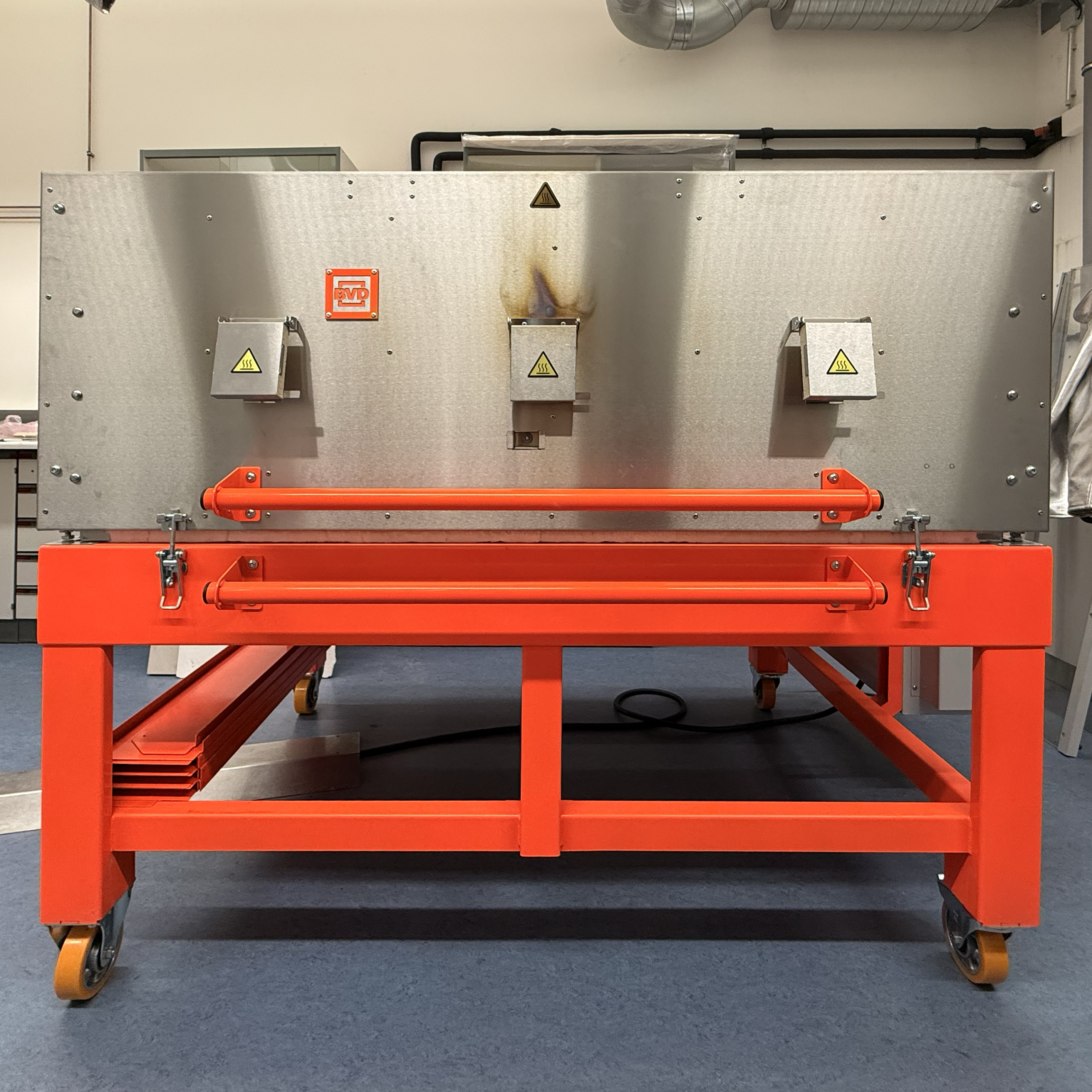
Sintering oven @Yan Lavallée

The sintering lab consists of multiple furnaces and optical dilatometers to quantify the evolution of fragmental materials during viscous sintering as observed at volcanoes or as an engineering method to fabricate materials. We use this equipment to study the densification process and the evolution of material properties (porosity, permeability, strength). This knowledge is currently used to develop bricks with tailored properties using lunar regolith as we seek to develop materials for lunar habitats.